1
The instrument
Fifteen scored rows and a legible band. Score any page, yours or anyone else's, in under an hour — and read the resulting shape as a diagnosis rather than a grade.
The 15-Superaxis Method for Creating Disruption in Fiction
Every writing manual tells you to break the rules.
None of them tells you which one, how far, or what it costs.
This one does.
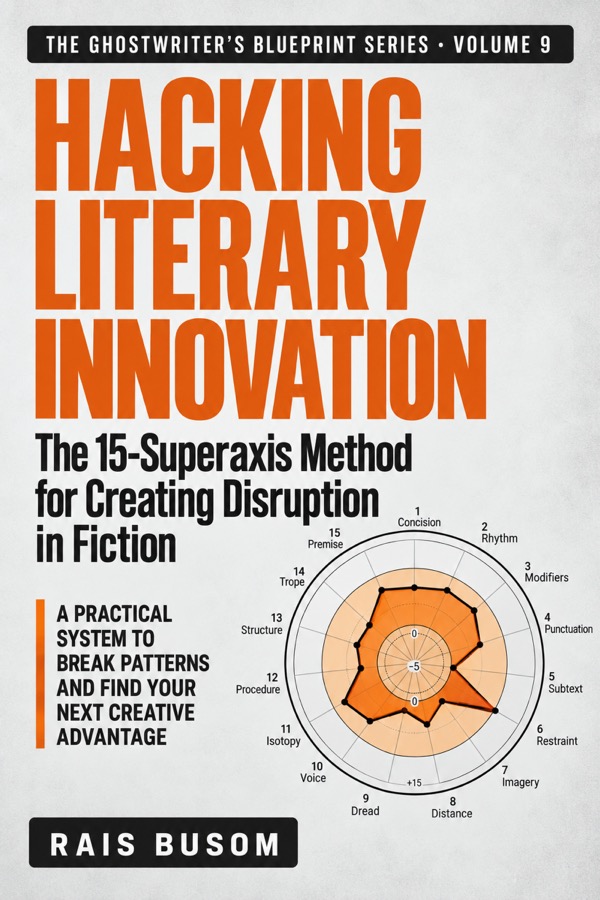
There are four hundred books on writing craft in print. Nearly all of them teach the same thing: the norms of competent fiction, and then, near the end, a chapter saying the great ones broke those norms.
What none of them supply is the part a working writer actually needs — which norm to break, how far to push it, and what the break will cost in readers.
Not courage. Not vision. Dosage. Fifteen superaxes describe every decision a novel makes, each on a scale a reader can feel. Push one hard and you have a signature. Push four and you have a book nobody finishes.
Fifteen scored rows and a legible band. Score any page, yours or anyone else's, in under an hour — and read the resulting shape as a diagnosis rather than a grade.
The disruptions readers forgive are the ones surrounded by absolute conventional competence everywhere else. The break that cancels your break is the second one.
Readers arrive with a fixed tolerance for difficulty and spend it in the first thirty pages. Learn to calculate yours, and whether your break is paid by the sentence or paid once and then converted.
Two directions, and only two. Every successful disruption either adds a constraint the reader must absorb or removes something the reader came for. Knowing which one you are doing changes how you execute it.
Not name-dropped — scored. Each one with its break identified, its anchors counted, and its cost named. Five broke one row. Four broke more, and the comparison shows what it did to them.
The four hundred other books. The hostile witnesses. Fifteen dials and a blind spot.
Paid by the sentence. What the page withholds. Paid once, and it converts. Take away what they came for. The acceptance budget.
One out, fourteen anchored. The break that cancels your break. Impose or empty. What the columns show.
Five books that broke one row. Four that broke more.
Six ways to lose a book.
Decide downward. Score upward. The authorial pact. Your break is going to disappear.
A master reference to all fifteen superaxes · a complete exercise program · an annotated reading list · troubleshooting.
Fifteen figures, every one generated from the book's own scoring tables. Chapter one holds a four-hour version of the whole method, so you can test it before committing to the rest.
Novelists who have finished at least one manuscript and suspect it is competent rather than distinctive. Ghostwriters and editors who need a diagnosis more precise than "it drags." Writers working with AI assistance who need to know which decisions are still theirs.
This is not a beginner's book. It assumes you already know how to write a clean sentence and want to know what to do with that skill.

Rais Busom is a writer, literary coach, and the founder of HumanInk.io, a suite of AI tools for writers. He created The Ghostwriter's Blueprint, a series of practical style-cloning handbooks, and has written all nine volumes: a Handbook for Literary Style and monographs about Hemingway, Auster, Le Carré, Chandler, Carver, Highsmith and Shirley Jackson. He is also the author of AWAP, the Augmented Writing Audit Protocol to certify manuscripts made by Assisted AI.
Chapter one contains a four-hour version of the whole system: the fifteen rows, the scale, and one scored example. Enough to run it on your own manuscript this weekend.